
I visited Hogwarts this week! I walked up and down the streets of Diagon Alley, I saw the cemetery where the graves of Tom Riddle, McGonagall and Moody can be found, I saw pictures of the Hogwarts Express, and I even saw the school sitting up on the hill! Okay, okay... I saw J.K. Rowling's inspiration for it all, at least! Edinburgh was a magical city filled with so much history. Walking down The Royal Mile, the main street, you really did feel like you were taking a stroll down Diagon Alley, walking past all the magic wand shops, owl pet stores, and wizarding hat emporiums. I visited the Café where Harry Potter was first born. J.K. Rowling would sit in The Elephant House and write for hours upon hours inventing the story of Harry Potter. A plaque outside of the store marks it as the birthplace of Harry Potter, and inside are a few pictures of J.K. Rowling and a few trinkets to be sold to Potter fans; but other than that, you would never really know that a legacy was born here... that is, until you walk into the bathroom.

 The second you open the doorway into the bathrooms, you are awed by the colors and words that cover every inch of white wall in the small room. You have to stand there and just stare for a second because of how incredible it is. Then, when you walk into the stalls, there is even more writing! There are quotes, thank you's, notes to J.K. Rowling, signatures, you name it! The toilet seat was by far the funniest, and my favorite though, and if you're a Harry Potter fan or at least have seen the movies you'll know where these sayings are from! Being in this place (the café in general not the restrooms) really inspired me to buckle down and start writing my own books. I know I want to be a writer, I just have to stop making excuses and do it.

What was truly amazing to see on the streets of Edinburgh was the history that still lived there. My Scottish family clan were the MacMillans, and I found so many articles and souvenirs bearing their name. The Scotts are proud of their heritage, or at least the tourists
 who come visit are. You could see the history on either end of the Royal Mile, from the castle on the hill (Hogwarts) all the way to the Palace of Hollyrood made famous by Mary, Queen of Scots. But, the real history lies below these fancy buildings. We took a tour called The Real Mary King's Close which showed us what the people of Edinburgh really lived like back in the day before they joined governance with England and became the United Kingdom. But the craziest part of all, it was all underground! An entire little village dwells under the streets of the Royal Mile, roads and houses built on top of it as the city expanded and grew. The living conditions back in those times were horrible. I don't even want to explain because you will be disgusted. We couldn't even take photos down there because of how dark many of the rooms were, but being able to walk through these streets and houses underground was simply incredible.

 By far, though, the most incredible experience I had in Scotland happened at sunrise. The first morning we were there, I got myself up at 5:30 in the morning, and a group of friends and I ventured off in search of Arthur's Seat. Today, it is a large hill/ mountain located in Hollyrood Park and overlooking all of Edinburgh. Legend has it that Camelot, the infamous castle of King Arthur, once sat at the very top. So, we were determined to climb it and watch the sunrise up over the mountains of the Highlands off in the distance. We didn't known that there were multiple paths up the hill and therefore, of course we took the first path we saw...probably the most difficult trail possible. I had never hiked ANYTHING before, and I was climbing up rocks, balancing on the edge, and praying for dear life I made it to the top alive. But, just as the sun was beginning to peek up above the mountains, I made it to the top. I felt as though I was on top of the world. The rocks glistened with dew and frost as the sunlight began to reach them, and I just could not help but think about how beautiful so much of this world is. I am so grateful for this experience; when else will I ever be able to say I hiked to the top of a mountain and watched the sun rise over the Scotland Highlands? And the best part of all? From the top we could see the easy trail that went down the back side of Arthur's Seat, and it was a peaceful stroll back down.

My expectations of Belgium: chocolate, waffles, beer. The reality: chocolate, waffles, beer, mussels, beautiful buildings AND "French" fries. Brussels is one of the most beautiful cities I have ever seen. It is full of importance and possesses an air of regality. You walk into the Grand Place and you feel as though you have stepped back through time. There are buildings towering above you in every direction of the square; but these building aren't the steel skyscrapers of New York, they are ornate mason structures with gold details and statues of important figures throughout history decorating their outer walls. City hall reaches up towards the sky and 300 of these statues of mayors, politicians, painters and more look down on the square at the hundreds of thousands of visitors who come to visit this majestic city each year.
 And the best part of all, my hostel was right down one of the streets that leads up to the Grand Place! All around the square was the best restaurants, waffle shops, frites shops and shopping! So, I bet you're wondering what a frite is right? Well, we call them "French" fries, but actually we are incorrect! Fries originated in Belgium and there are Belgian Frite shops everywhere! And what goes better with fries than a nice warm waffle? My favorite waffle shop was called Los Churros and Waffles and I fell IN LOVE with a Belgian sauce they had called Speculoos. It is similar to Nutella except that it tastes like Teddy Grahams or graham crackers! It was so delicious, I ate at least one a day. I mean, look at them, how couldn't you?

We toured the city in the most fairytale-esque way possible... a horse drawn carriage of course! The carriage ride was perfect, just 30 minutes and we got to see the main attractions around the square. We learned about all of the important buildings standing today as well as those we could no longer see. We learned that the city before us was not the original Brussels, the real Brussels was actually below our feet. The city had been destroyed by wars in the 13th century and the people built a bigger and better Brussels on top of the ruins. Down one of the side streets, though, you can actually see some of the ruins of the city below ground through glass panels!
 While on the carriage ride, we passed by beautiful business and government buildings dating back to the 17th century that Brussels is famous for as the capital of the E.U. Around one of the corners of these majestic buildings, we saw a little boy peeing! His name is Mannekin Piss and he is actually a statue on the outskirts of the square. Technically, he's a fountain... of a little boy peeing, if you catch my drift. The legend goes that back in the days of the wars, a little boy peed on one of the bombs in the streets, stopping it from going off and saving the lives of many people! And so, they erected a statue in honor of the little peeing boy.
 On the other side of the city (a metro ride away, DO NOT attempt to walk!) there is a massive structure called the Atomium. It is known as the Eiffel Tower of Belgium. The structure resembles a giant atom, but you can actually go inside of it. Stepping inside, you feel like you have entered the Twilight Zone. The balls all hold displays of both the creation of the structure as well as objects from past decades showing what the future was thought to look like. You travel from ball to ball by the escalators that are within the tubes connecting them. Traveling through those feels like you are in an episode of Star Trek; the lights change colors, and the round windows above allow you to see up into the sky. But, when you get to the top, you can see why it is called the Eiffel Tower of Belgium; the views of the city are incredible. We went at dusk right before closing time, and we watched the sun set over the city of Brussels. It was a beautiful sight to see.
 My favorite day, however, was definitely Valentine's Day, or Gal-entine's Day as my friends and I called it. We took a train an hour north to the smaller city of Bruges. Getting off the train into the city, I felt as though I had stepped back 300 years in time. The city looks as though it is right out of the pages of a fairytale. Everywhere you look, there are cobblestone streets, horse-drawn carriages, and beautiful French and Dutch inspired houses. Canals run through the streets, and beautiful ornate churches can be found around every corner. There is a city square, just like that in Brussels, and the entire place is surrounded by beautiful colored shops, a massive tower, and plenty of old, majestic buildings. The city was a land of romance, and spending Galentine's day there was the best decision we made. It didn't hurt that Bruges is the chocolate capital of Belgium, either! I bought so many yummy pieces, and they were all gone by the end of the day! Bruges is now my new favorite city, and I hope to travel back there someday.. maybe with my own Valentine on my arm!

 I took a huge step this past week; I made my first international excursion without the aid of my parents! Now, I didn't say the trip went entirely without a hitch.... I accidentally left my passport at the hostel on the journey back to Ireland and didn't realize it until an hour and a half later when I was at the airport. Needless to say, I missed my flight and had to pay a hefty price for a new one, but hey, lesson learned. I will now always check to make sure I have that little blue book before I leave. It could have been worse, I could have lost it!
In just 3 days, the beautiful city of Amsterdam became my favorite place in the world (I'm sure I'll say that about every place I go, but for now it's Amsterdam). The city is shaped like a half moon or the smile of the Cheshire cat in Alice in Wonderland. Canals run through the entirety of the city, and beautiful old Dutch houses line these canals side by side in seamless rows. The houses were what made me fall for the city, not just for their beautiful architecture, but also the story behind them.
I took a free walking tour the first morning that I arrived. It was so perfect, the guide picked us up right from our hostel, the famous Flying Pig where many travelers stay, and we all walked to Dam Square where the free tour leaves from every day. It was my guide who told me the story of the city and these buildings I saw. I had noticed that some of the houses were crooked, others leaned into the streets, and every single one of them was as narrow as could be.
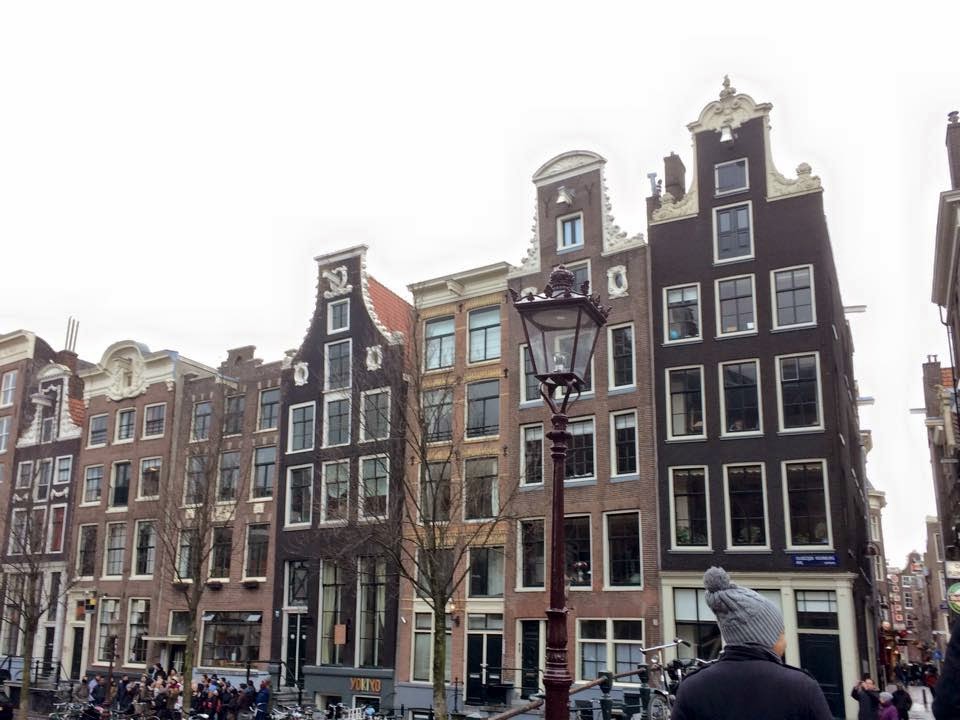
He answered all three of my questions first with the simple answer: The Dutch do anything they can to save money. Of course, this didn't make any sense to me, so he went on to explain what he meant. A long time ago, Amsterdam was a marshland with the Amstel river running through it. In order to make a city on top of these wetlands, the Dutch had to dam the Amstel (hence Amsterdam). To build houses on the soft soil, they took logs and thrust them deep into the ground in order to create stilts for the houses to be built on top of. Through the years, of course, some of these logs have rotted through, making sides of some of the houses sink into the soil slightly. This is what causes them to be crooked. But why don't the Dutch fix this? Well, the houses are all so close that when one is crooked, it leans up against the house beside it. The way the Dutch see it, if the house isn't going to fall, then why spend the money to fix it? Instead, they even out the floors and the windows on the inside to make the house appear to be straight. But if you're on the street, you will notice their crookedness.
 As for the narrowness and front leaning of some of the houses, those go hand in hand. In the old days, property taxes on houses in Amsterdam were determined by the width of the house. Therefore, because the Dutch like to save every penny possible, narrow houses 5 stories high were the result. Now, how does one fit furniture and storage into these narrow houses and then proceed to carry them up those 5 steep flights of stairs? Why, you make a pulley on the outside of the house, of course, and hoist everything up through the window. But, how do you make it so that the items being pulled up don't break the windows when they sway? The Dutch thought the best solution to this was to build houses that tilted forward slightly so that the objects wouldn't hit the glass. It was too late before they realized that they could just make the pulley longer.

Unfortunately, I didn't have enough time to make it to the Rijks or Van Gogh Museums, but I did get to see the I Amsterdam sign that is outside between the two. It is very crowded during the daytime, and difficult to take a picture of it. But my friends and I found that if you go back when it's dark, the pictures don't turn out quite as well, but there's no one there in the way of the sign! I also toured Anne Frank's House and they have done an amazing job with the museum and features throughout. Definitely worth the wait in line.

My final three comments about the beautiful city of Amsterdam:
1. Try the strropwaffles! Regular cookies will never taste the same again.
2. When crossing the street, watch out for bicycles more than cars.
3. The Red Light District looks EXACTLY how you would expect.

Do you remember your first kiss? The first kiss I got yesterday gave me more than just butterflies in my stomach; it bestowed on me the gift of eloquence, or as some call it, the gift of talking your way out of anything. Yes folks, I kissed the Blarney Stone! But, it isn't as simple as leaning over and kissing a rock; you have to be lowered down the side of the very top of Blarney castle and held on to by someone as you cling for dear life onto the iron rails sticking out of the wall above your head. Terrifying, right? But I did it! I conquered one of the world's 99 things to do before you die and joined the millions of visitors over the past hundred years who have kissed the stone. The term blarney actually means "clever or flattering" as in a way with one's words. As Irish politician John O'Connor Power once said, "'Blarney is something more than mere flattery. It is flattery sweetened by humour and flavoured by wit. Those who mix with Irish folk have many examples of it in their everyday experience." There are many stories explaining the origin and meaning of the stone, but the one story that everyone holds true is the stone's powers of bestowing the gift of the gab.

Blarney castle is the first castle I've gotten to actually go into while on this trip, and let me tell you these pictures do not do it justice. First off, the thing is MASSIVE! It towers over the tops of the trees and if you are brave enough to climb the incredibly steep winding staircase all the way to the parapet where the stone sits, then you can see a spectacular view of the rolling green hills of County Cork. Although the castle has seen many renovations through the centuries, much of the original stone castle still stands in place. The original stone structure was built in 1446 by Cormac Laidir McCarthy, but even before that there stood a wooden structure built in the 13th century as a hunting lodge. Through nearly 600 years this castle has seen wars, besieges, and many families and visitors, and yet still it stands tall with all of it's history seen in the names and dates carved into the castle's stone walls.

What I wasn't expecting to find at Blarney was all the other attractions to see! The grounds of the castle boasts two beautiful waterfalls, flower gardens, a poison garden, a pond, walking trails, and even an area called the Rock Close where magic and mystery dwells. The entire grounds looked like a whimsical enchanted forest; at times I felt like I had come straight out of the pages of Alice in Wonderland or Snow White.
In the Rock Close, the legends say there lives a witch who has lived on the castle grounds for centuries and could have been the one to tell McCarthy of the powers of the Blarney Stone. Tourists can see the ruins of her kitchen built into a giant rock, there is a stone that forms the shape of a witch's face, and there is even a rock that sits balanced on the points of two smaller rocks which could have only gotten there by somehow being lifted (not very likely) or... magic.
 The legend I found best of all in those enchanted woods were those of the Wishing Steps. The legend says that the witch must grant each of the visitor's one wish in return for the wood she uses from the castle grounds to heat her fires. However, in order to fulfill this wish, the visitor has to walk up and down the wishing steps with their eyes closed, thinking of nothing else but their one wish. If they can do this, then their wish will come true for the rest of the year. It is a difficult task to do, let me tell you! The stairs are uneven and you walk into a dark cave, but I did it. The best part of it all was right after, when I was walking on the trail, I saw a fox sitting in the middle of the path just staring at me. I swear it was the witch.
 After the castle, I set off and explored a bit of Cork City. It is the second largest city in Ireland, next to Dublin, and yet "city" is still a very loose definition of it. But, there is a lot of history in Cork, and I would definitely recommend taking a hop on hop off tour to see the city's attractions. I did not, and my friends and I ended up walking about 12 miles in total to see all of the historic sites. We got our exercise in for sure, but we were exhausted by the end of the day. Just to highlight a few of the unique structures in the city, here is the original Red Abbey tower, below is one of the many beautiful churches you can see throughout Cork, and the old Cork City Gaol (jail) filled with history and writings on the walls done by the rebels who helped Ireland gain it's independence. And the final picture is the entrance to the city park and my favorite photo from my trip to C
ork. See the face?

Guess what; there's a Boston, Ireland! We passed the sign for it when I went on my first excursion today with my study abroad program, API. The excursions included in my trip to Galway were actually a huge reason why I chose API as my abroad program provider, and I am so glad I did. Not only do I get to go on some incredible excursions around Ireland and even to Edinburgh, Scotland, I also had the chance of meeting Kevin and Finn, my program directors. They are the most wonderful couple and mentors I could have asked for on this trip. Finn refers to herself as our "Irish sister" and she truly lives up to that title. The pair of them are a fountain of information and resources as we plan our own trips around Europe and encounter the day to day challenges of living in a foreign country. They have many stories to tell and are very admirable and influential people. Oh, and their children are so adorable! But, Finn and Kevin have made this transition into a new country so easy and I am so grateful for their guidance.

Anyways, all 40 of us in my program loaded onto the bus at 10 a.m. and headed off in the direction of County Clare. Along the way, we made a stop at Dunguaire Castle on the very outskirts of the small oysetring town of Kinvarra. The tower was built in 1520 by the Hynes clan (ironic, Hynes is my boss's name from the restaurant at home I work in and he told me that his family is from Galway!) How cool is that?! So anyways, the castle has since been restored to as we see it today, and you can actually use the castle's banquet hall for events!
 From here, we travelled up to the Burren in County Clare. The "Burren" is derived from the Irish word "Boireann" meaning "Land of Rock". The Burren is a national park of Ireland and much of it is covered in... rock! It is Limestone, to be exact, and according to our wonderful tour guide, Tony Kirby, author of "The Burren and The Aran Islands: Walking Tour", 50% of Ireland is covered in the stone. Fissures called grikes can be seen running their course through the stone, and plants grow through these cracks. The climate is an interesting aspect of the Burren. the temperature stays fair through January (sunny but just a tad nippy today) and for this reason, it has some of the best agriculture in all of Ireland and Britain and sustains a variety of plant growth. The Burren, ironically, is also where most farmers bring their cattle up to when the winter months set in. This isn't because of the cold, more so than that if the cattle were left elsewhere, they would destroy the fields from grazing due to the heavy winter rains in Ireland. In the Burren, there is so much green and the climate is so temperate that there is no worry about the cattle harming the agriculture.

As we continued along through the Burren, we could see miles and miles of stone walls built along the expanse of the hills. They looked like lines etched out of the ground and traveled as far as the eye could see. The guide informed us that in Ireland, if all the rock walls were put together, they would expand over 250,000 km; that's a lot of stone! These walls were often used as land perimeters, but many in the Burren region were also formed as a way to keep animals out of the agriculture. There were two kinds of walls. The shorter walls were made to keep sheep in and rabbits out of the farmlands. The base of the wall was made with horizontal stones wedged together so that rabbits could not fit through the cracks, while the top was made with vertical stones that allowed a small amount of sunlight to shine through that detracted the sheep away so that they wouldn't attempt to jump the wall. The larger walls, as pictured here, were made entirely of horizontal stones jam packed together and built tall in order to keep deer out of the fields. Neither of these walls were made with any kind of mortar. They are known as dry stone walls because of this, and I don't know about you, but it amazes me that they are still standing hundreds of years later.
 Our next stop was at the ruins of an incredible old monastery. This tiny church seen through the trees was built 1000 years ago at the height of pilgrimage into Ireland. It is a church in honor of the Saint Cronan, and directly outside of the church is a shrine in his honor.

 The shrines at one point in time held relics of the saints such as their bones, robes, books, and more. The shrine here is a miniature replica of the church, and although the relics have since been lost or stolen by thieves, the significance still remains. The entrance to the church is surrounded by a ring of rock, marking the sacred grounds. On the grounds of the church, a convict would no longer be under scrutiny of common law, but instead was under church law and in the hands of God and could escape conviction. At one point in time, the church was thought to have a thatched roof as it's cover. It was restored by European settlers, as depicted by the arched entrance on the north wall as well as the
small human and animal-like faces carved into the stone. Despite the changes made, the bones of the church still remain in tact, and it is an incredible sight to see. To think that this church has seen 1000 years of history and human life is incredible.

We left the Burren and began our trek back through County Clare. We couldn't leave, however, without a stop at Hazel Mountain's Chocolate. It is a local chocolate factory at the base of the Burren mountains which produces its chocolate entirely from scratch. The house was once owned by the chocolatier's grandparents, and it is now an adorable café where you can sit and enjoy homebrewed hot chocolate, brownies, pastries, and of course delicious chocolates. Hazel Mountain Chocolates is Ireland's only bean to bar chocolate boutique. What this means is that the company buys their beans direct from the cacao farmers in Madagascar, Colombia, and Venezuela, and takes those beans and roasts them and then melts them down into the chocolate bars we know. There are two ingredients that they use in their chocolate, cacao beans and sugar cane. That is all. Any fillings or toppings such as caramel or pralines are made from scratch in the store, and the crushed berries and nuts are bought fresh or grown.
 You can tour the one room factory and get samples of the delicious chocolates, but be careful because I guarantee you will go into the store after and buy some! I bought a dark chocolate with hazelnut and salted caramel bar as well as three truffles, a dark chocolate salted cocoa one, a milk chocolate and Guinness truffle, and something else with a pistachio crumble. There is so much flavor and creativity in each of the chocolates that I can't choose which one I like best!
It was a great trip off the beaten path of the traditional bus tours of the Burren, and if nothing else, if you're ever in Ireland, stop at Hazel Mountain Chocolates and do some taste testing!
Another beautiful day in Galway! First, some friends and I walked down to Shop Street where they hold a local farmer's market every weekend. And, unlike many of the markets I tend to find back home, this one stays open until the sun sets! There is a variety of tents with crafts, fresh bread, local produce and fish, and much more! We keep hearing about these infamous homemade doughnuts sold at the market, but we have yet to come across them! The past two weeks the Doughnut man hasn't shown, but hopefully I'll be able to tell you all about their deliciousness after next weekend! Third time is a charm, of course!
 After the market, we made our way back towards Claddagh and The Long Walk. We walked further on the trail where the fields are, and ended up at the entrance to a small island with a lighthouse. But, right before the lighthouse there was a beautiful bench sitting at the entrance. I had actually been looking for this bench ever since I came to Ireland. This bench is a big part of the reason why I chose to come to Galway. I had known I wanted to study abroad because of the stories I had heard my older cousins tell me about their adventures. When they came to visit Galway, they were stunned by it's beauty. They walked the same trail I had this morning and found this bench with the intricate circles and the saying that reads, "Life is for Living." My cousin told me that if I ever came to Ireland, then I would have to find her bench and think about her being here in that same spot 5 years earlier. The quote spoke to her and it really spoke to me, too. Life is not about going through the day to day motions, it is about living and experiencing the world, just as I am doing.
 Living is also what my ancestors did when they fled Ireland during the Great Famine and came to America. The island that I mentioned above with the lighthouse is called Mutton Island and that lighthouse is the last piece of Ireland they saw before their journey. If my ancestors had not chosen to take that journey, I wouldn't be here today to even write this blog. You can walk the length of the bridge to the lighthouse, however, the island itself is closed to the public. Continuing down the road, there is a small park with three stones dedicated to the captains and crew as well as all the men and women who took the leap of faith during the famine and came to America. The stones explain the significance of the lighthouse and lists the names of the hundreds of ships.
 At this point, you enter an area of Galway known as Salt Hill. We didn't get to explore too much of this village, but we do know that it is famous for it's beautiful ocean views and casinos! Yes, I said casinos! There are also beautiful villas and hotels for travelers to stay at. We passed the Galway
 Aquarium, which we unfortunately did not go into because we were STARVING. But, right passed the aquarium, we found a little bar called Olso's. It's Galway's only microbrewery and home of the famous Galway Bay beer! We walked in and were able to taste a few of the options and I ended up with a DELICIOUS chocolate milk stout called Burried at Sea. They had a great deal going on where you could get a pint of beer and a burger for only 10 Euro! I had a chicken burger with caramelized onions that was AMAZING! It was a great deal and so delicious AND we got to try the local beer! In addition, there was a massive screen playing the day's rugby game. I wonder if they'll air the Patriot's game tomorrow night at 1 a.m. here? Hey, a girl can hope!
That's all for today! Tomorrow I am traveling up the coast of Galway to a place called the Burren, so keep posted to find out all that it has in store!
Well, what do you know, the sun does shine in Ireland! It doesn't happen often, but when it does you had better take advantage of it! Yesterday was one of these sunshine days; it started off drizzling per usual, but then a miracle happened! The clouds broke and there was sun! For an entire 6 hours it was sunny and beautiful in Galway!

I started off exploring where NUIG all began. Pictured here is the Quadrangle and it is the original building on the campus. When the university first opened its doors for teaching in 1849, it was called Queens College, Galway with sister colleges in Cork and Belfast. There were only 37 professors and 91 students whom comprised the college's 3 faculties, the Arts (including Science and Literature), Law, and Medicine as well as a school of Engineering and Architecture. The story goes that this architecture was nearly used as the building for the Queens College in Belfast, but good thing it wasn't because this building and it's beauty was one of the main reasons I wanted to come study at NUIG! There are also some very notable alumni who have walked these very halls . First, there is Alexander Anderson who is credited as the first person to announce the existence of black holes; class of 1881. Then, there was Professor George Johnstone Stoney who is known as the scientist to first coin the term 'electron' which led to the particle's discovery 40 years later! In the sports world, NUIG sent more athletes to the Beijing Olympics than any other Irish University! And to think that I am walking the same halls today as these incredible men and women; it is quite an honor.
 From here, some friends and I traveled the river walk which travels the length of the city's famous river, the River Corrib. It is one of the shortest rivers in Europe, but in terms of water flow, it is actually the second largest in Ireland. Trust me, do not go jumping into that current! Old architecture can be found all along the sides of the river, and it is so beautiful to travel down toward the village of Claddagh, where you find the famous Spanish Arch and The Long Walk, a promenade which overlooks the harbour.
 The Spanish Arch, locally called the Sparch, was built in 1584 and was built as an extension to the town wall in order to protect the city's merchant ships from looting. I've been trying to find the reason why the arch is called the Spanish arch, however, from what I can tell, there is no actual association between the arch and Spain other than some Spanish merchant ships using the wall extension as protection. The Spanish Arch was the home of the Galway city museum, but it has recently moved to a brand new building right down the road, and it's FREE!

I would definitely call the colorful houses (the ones pictured at the top of this blog!) one of the most photographed locations in Galway. The houses are located on The Long Walk and can be seen from the village of Claddagh which was known as the fishing village of Galway. There are many boats floating in the harbor as well as many pulled up onto the shore. My favorite was the one called the Kingfisher because that is actually the name of my street back home! It was a nice little reminder that despite how far away I am, home is always nearby. There is another beautiful trail called NimmO's Pier that follows the city's coast and hosts a number of rugby, hurling, and Gaelic football fields. The Long Walk was once a place where Claddagh women sold the fish that their husband's had caught that morning in the park where the fields now stand.
It was a beautiful walk on a very beautiful day and lots of pictures can be taken here! My friends and I have vowed to return on another sunny day and bring a picnic and watch the sun set over the same Atlantic ocean I can see from back home.


